
Ever wondered why some places show up when you search “pizza near me” and others don’t? They’ve put time into local SEO. The same thing happens every day in senior living, when an adult son searches “memory care near me” or “assisted living in Wakefield, MA”.
Local SEO is the work that helps your community appear in those searches, especially in the map results at the top of the page. It’s one of the few places a single community can outrank a large operator or a national referral site, because Google cares a lot about being close and being relevant to the searcher. Here are five strategies that make the biggest difference.
1. Claim and complete your Google Business Profile
Your Google Business Profile is what shows up in Google Maps and the local results. If a family can’t find your address, phone number and directions quickly, they’ll move on to the next community.
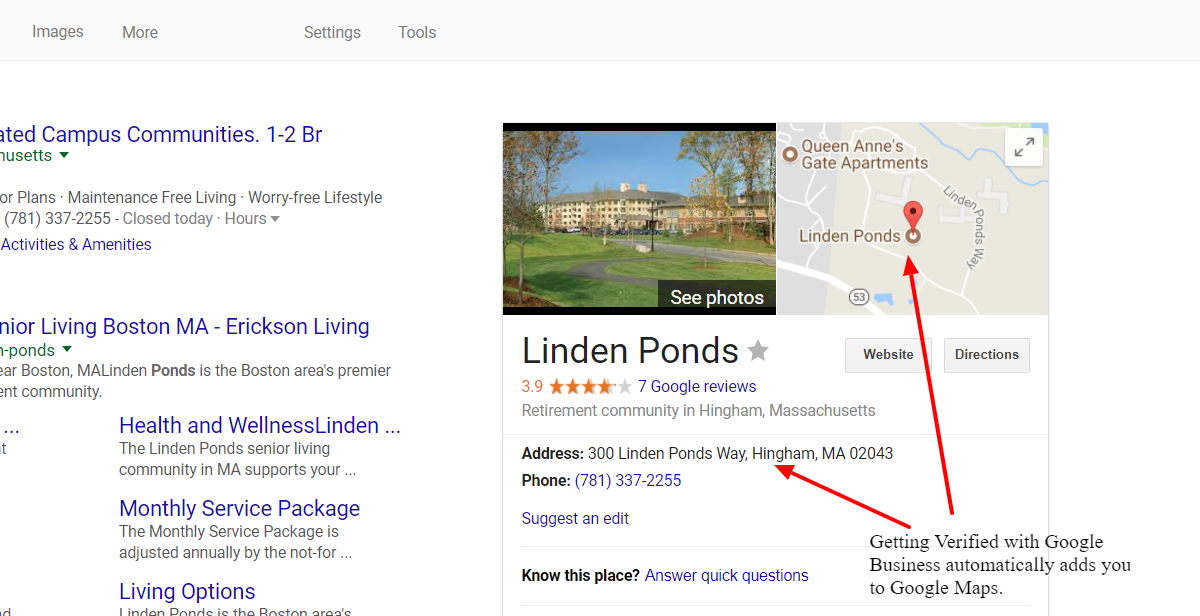
- Claim and verify a profile for every community (not one for the whole company).
- Pick the right categories, such as assisted living facility, memory care or retirement community.
- Add real photos, hours, care types, and a link to the page for that specific community.
- Keep it up to date, and post updates and events there too.
2. Keep your name, address and phone number identical everywhere
A local citation is any mention of your community online that includes its name, address, phone number or website. Google uses these to confirm you are where you say you are. When they don’t match, for example “Suite 100” on one site and nothing on another, or an old tracking number on a directory, it weakens your local ranking.
Start with the free listings: Google, Bing, Apple Maps, Facebook and Yelp. Then add senior-living directories families actually use. Make sure your name, address and phone number appear exactly the same on all of them and on your website.
3. Earn reviews, steadily
Reviews are a local ranking signal and a trust signal at the same time. A steady flow of recent, specific reviews helps you rank and helps the family deciding between you and the community down the road. Our step-by-step guide covers how to ask: How to Get More 5-Star Google Reviews for Your Senior Living Community.
4. Create content about your local area
Content that’s genuinely about your area gives Google a reason to connect your community with local searches. It’s also where smaller communities can beat bigger operators with bigger budgets, because it shows you’re part of the neighborhood.
- Local guides: “How to choose an assisted living community near Wakefield, MA”, or “Best places to watch fireworks near Waltham, MA”.
- Local versions of common questions: add the place name to titles and headings where it fits naturally, for example “how to choose a senior living community near Boston, MA”.
- Stories from residents and families: interviews, testimonials and videos help you get found and give families peace of mind.
- Formats that suit your audience: blog posts, short videos, checklists and community event recaps.
Share each piece on your social channels, with local hashtags, so it reaches people nearby.
As Rand Fishkin, co-founder of Moz, put it: “Content marketing is a more competitive environment certainly, but those who have real empathy for web users and influencers AND have the SEO skills to infuse their work with great keyword targeting, search accessibility, etc., are going to have ongoing success.”
5. Build local links the right way
Links from other trusted websites tell Google your community is credible. For local SEO, links from local organizations matter most.
- Local clubs, charities, chambers of commerce and senior outreach groups you already work with. Often it just takes asking the site owner.
- Local news coverage of events and resident stories.
- Guest articles on local or industry blogs that link back to your site.
Don’t buy links or use link schemes. It doesn’t work long term, and it can hurt your rankings. Andrey Lipattsev, Search Quality Senior Strategist at Google, named high-quality content and links as two of the most important signals Google uses to rank websites.
Local SEO takes time, and it compounds
Unlike paid ads, local SEO costs time and effort rather than a bid for every click. It takes a while to set up properly, and search algorithms keep changing, but the results build on themselves. A community that keeps its profile current, earns reviews and publishes useful local content keeps gaining ground.
Key takeaways
- Claim and complete a Google Business Profile for every community.
- Keep your name, address and phone number identical on every listing and on your site.
- Ask for reviews as part of your normal process.
- Publish content about your local area, not just senior living in general.
- Earn links from local organizations instead of buying them.
Showing up in local search is only half the job. The other half is answering fast when a family calls or fills in a form. If you’d like help with both, book a call with NextWave.
Related reading: PPC Tips for Senior Living Communities · How Speed-to-Lead Became the Easiest Unfair Advantage in Senior Living