
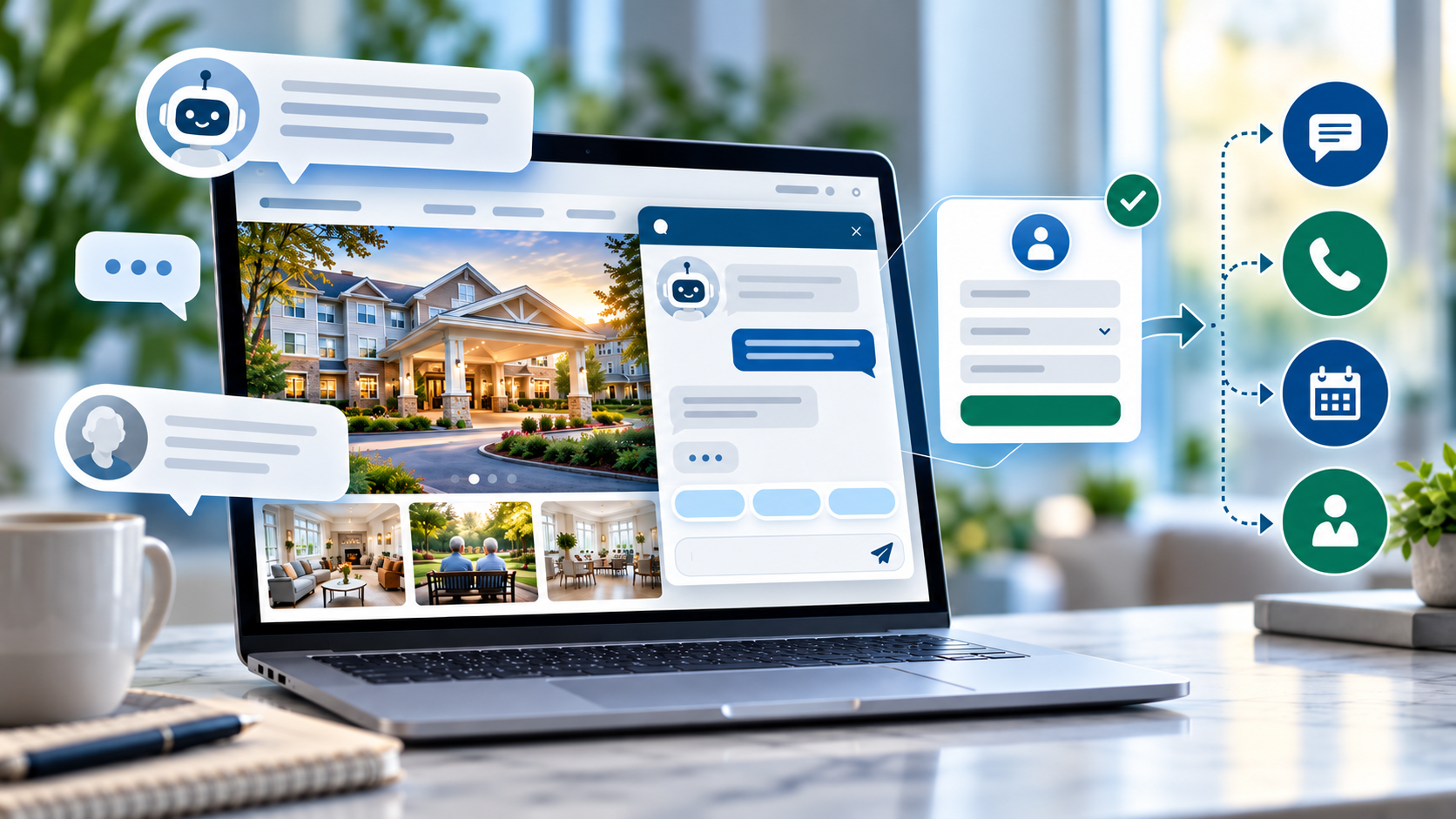
A website chat tool for a senior living community is software that answers visitor questions, collects contact information, and in some cases qualifies prospects, directly on the community’s website, either through a live chat widget staffed by a person, a rules-based bot, or an AI agent that holds a real conversation.
The tools in this category range from simple pop-up widgets to full AI virtual sales assistants that write directly into a CRM. What separates a good one from a bad one for a senior living sales team isn’t how smart the AI sounds.
It’s whether the tool has hard limits on what it can promise a family about pricing and availability, whether it hands a qualified prospect to a live person fast, and whether the conversation actually lands in the CRM your sales team works from. This comparison looks at four tools senior living operators are actually using or evaluating right now, judged against those three criteria.
How These Four Chat Tools Compare
| Tool | What it does | CRM integration | Live handoff | Pricing (as of September 2026) |
|---|---|---|---|---|
| Further (AI Web Conversations / Virtual Sales Assistant) | Senior living specific AI chat, conversational forms, and readiness-scoring surveys | Syncs customer data via integrations (specific CRMs not listed on the product page) | Not detailed on the product page | Not published, free trial offered, demo required |
| Roobrik Chat | Senior living specific chat plus a built-in care-readiness and affordability assessment | Native integration with Welcome Home, ALINE/Enquire, Salesforce, HubSpot, and others | Connects prospects with "an advisor," handoff mechanics not detailed | Custom, per-community pricing, contact for quote |
| Hyperleap AI (Senior Living Agent) | General-purpose AI chatbot builder with a senior living template, answers care-level and pricing questions, routes urgent cases | None. Hyperleap states plainly it does not hold, write, or confirm appointments in a CRM | Shares a booking link and emails a summary to the admissions team, doesn’t book directly | Plus $40/mo (3,000 responses), Pro $100/mo (12,000 responses), Max $200/mo (30,000 responses), 7-day free trial |
| HubSpot Breeze Customer Agent | General-purpose AI chatbot built into HubSpot’s CRM, resolves common questions and escalates the rest | Native, since it’s part of HubSpot’s own Smart CRM | Built to detect when a human touch is needed and passes the conversation with full chat history | Requires HubSpot Professional or Enterprise (roughly $450+/month) plus $0.50 per resolved conversation under HubSpot’s 2026 outcome-based pricing |
Senior Living Specific Virtual Sales Assistants
Further and Roobrik Chat are built specifically for senior living, not adapted from a general customer-service product.
Further: AI Web Conversations and Virtual Sales Assistant
Further’s AI Web Conversations product is what the company calls a Virtual Sales Assistant, described on its own site as built to "optimize the buyer journey and maximize move-ins from websites."
Key features that matter for a senior living sales team include conversational web forms that automate discovery and tour scheduling, and a web survey feature that walks families through a structured care-needs and financial-readiness assessment, generating a "Readiness Score" the sales team can use to prioritize who to call first.
Further’s strength is that it was built for this exact buyer journey from the start, and the readiness scoring gives a sales team more than just a name and phone number to work with.
The limitation is that Further doesn’t publish pricing or explain its live-handoff process on its public site, so a community has to book a demo to find out how, or whether, a qualified lead actually gets routed to a person quickly. Further is best for a mid-size to large operator that wants a senior living native tool and is willing to go through a sales process to see the details.
Roobrik Chat: Chat Plus Built-In Decision Support
Roobrik Chat combines a standard chat widget with Roobrik’s existing decision-support assessments, the same kind of tool used to help families figure out what level of care they actually need.
The product answers common questions directly, "from pricing to tour availability," and captures more than 20 data points per prospect, including readiness for senior living, specific care needs, current living situation, and family dynamics. Roobrik reports that nearly a third of users who chat also engage with the deeper decision-support content.
Roobrik Chat’s strength is CRM reach. It integrates natively with Welcome Home, ALINE/Enquire, Salesforce, and HubSpot, among others, which covers most of the CRMs senior living operators are already using. Roobrik doesn’t spell out exactly how or how fast a chat conversation gets handed to a live advisor, only that the tool "helps prospects connect with an advisor." Roobrik Chat is best for an operator that wants chat and a care-needs assessment in one product instead of stitching two tools together.
General-Purpose AI Chat Tools Used in Senior Living
Hyperleap AI and HubSpot’s Breeze Customer Agent weren’t built for senior living specifically. Both get used in the industry anyway, usually because a community already has the surrounding platform, a CRM in HubSpot’s case, or wants something cheap and fast to set up, which is Hyperleap’s case.
Hyperleap AI: A Budget-Friendly Senior Living Chatbot Template
Hyperleap AI offers a senior living agent template on top of its general AI chatbot builder. It handles care-level explanations across independent living, assisted living, memory care, and skilled nursing, answers pricing and amenity questions, and supports more than 100 languages.
On lead capture, Hyperleap "captures name and phone, and emails your admissions team a clean summary," including which care level the family is considering, their timeline, and preferred location. For urgent situations like a hospital discharge or a fall, it routes the conversation straight to the admissions director with full context attached, while still collecting a callback number.
Plus plan runs $40 a month for 3,000 responses, well under what the senior living specific tools or HubSpot’s agent cost. The real limitation is CRM integration, or the lack of it. Hyperleap states directly that it does not hold, write, or confirm appointments in a CRM, so every lead still has to be manually entered by someone on staff. Hyperleap is best for a single community or small operator that wants a low-cost way to cover after-hours questions and isn’t relying on the tool itself to keep CRM records clean.
HubSpot Breeze Customer Agent: An AI Chatbot Native to the CRM
HubSpot’s Breeze Customer Agent is an AI chatbot built into HubSpot’s own Smart CRM rather than a separate senior living product. It draws on a company’s help center content, website pages, and other documents to answer questions, and HubSpot reports it resolves 65% of conversations and cuts resolution time by 39% across more than 8,000 customers using it.
The feature that matters most for a sales team is the handoff design. The agent is built to spot questions that require a human touch, and when it hits one, it passes the conversation to a live rep along with the full chat history, so the prospect doesn’t have to repeat themselves.
There’s no separate integration to maintain because the chat, the CRM record, and the handoff all live in the same system, which is exactly the setup one NextWave client moved to after leaving a senior living specific chatbot.
The limitation is cost and complexity. It requires a HubSpot Professional or Enterprise subscription, roughly $450 a month and up, plus a resolution fee of $0.50 per conversation under HubSpot’s 2026 outcome-based pricing, and it isn’t purpose-built for senior living questions the way Further or Roobrik are. HubSpot Breeze Customer Agent is best for a community or operator that already runs its sales process through HubSpot and wants chat to live in that same system rather than bolt onto it.
How to Choose a Website Chat Tool for a Senior Living Community
A chat tool is a fast, always-on front door. Someone lands on the site at 9pm, has a question the FAQ page doesn’t quite answer, and doesn’t want to fill out a form and wait.
Where communities get into trouble is asking a chat tool to carry a conversation that used to require a person on the phone, working through hesitation, reading what a family actually needs versus what they’re asking for on the surface, deciding when to push and when to back off.
One NextWave client ran a senior living specific chatbot for a while and saw lead volume go up, but a growing share of those leads turned out to be people who were financially unqualified once a real conversation happened, mostly people who’d used the chat window to get a price and nothing else.
The client has since moved to an AI assistant with tighter guardrails, no commitment to pricing or availability, and a clear trigger for when it hands the conversation to a live salesperson instead of trying to finish it alone.
Before signing with any of the four tools above, or any chat tool, get a straight answer on three things.
What exactly can the AI commit to on pricing and availability, and can that be locked down. A tool that quotes numbers or promises open units on its own is going to generate leads that fall apart the moment a real person gets on the phone.
What triggers a handoff to a live person, and how fast does that handoff actually happen. Of the four tools compared here, only HubSpot’s Breeze Customer Agent and Roobrik Chat describe a live handoff at all, and neither spells out the speed. Ask directly.
Does every conversation write back into the CRM automatically, or does someone have to pull that data out by hand? This is where Hyperleap AI falls short for anyone running a real sales process, since it has no CRM integration at all.
This matters more than it might seem, because the tool sitting on top of a slow follow-up process doesn’t fix that process. NextWave’s own research across 150 senior living communities found sales teams making fewer than two follow-up attempts per lead on average, when it typically takes seven to nine touches to get a prospect on the phone. A faster chat widget on the front end doesn’t change what happens, or doesn’t happen, after the lead lands in the CRM.
This isn’t a senior living specific problem either. A 2026 industry review found chatbot adoption running at 58% in real estate and 52% in healthcare, well behind retail and banking, and pointed to the same reason every time. The emotional stakes per interaction are higher in those categories, and so is the cost of a wrong answer. Chatbot Statistics & Trends By Industry Senior living sits in exactly that category.
Which Website Chat Tool Does Your Senior Living Community Need?
If the priority is a tool built specifically for the senior living buyer journey, with a care-readiness assessment built in, Roobrik Chat or Further are the two worth demoing first.
If the community already runs its sales process inside HubSpot and wants chat to write directly into that same system without a separate integration, the Breeze Customer Agent is the more natural fit despite the higher cost. If the budget is tight and the goal is mainly after-hours coverage for basic questions, Hyperleap AI is the cheapest way in, as long as someone is entering leads into the CRM by hand afterward.
Whichever tool gets chosen, the questions above, pricing guardrails, handoff speed, CRM write-back, matter more than the brand name on the widget.
Frequently Asked Questions
What is the best AI chatbot for a senior living community in 2026?
There isn’t one best product for every operator. Further and Roobrik Chat are built specifically for the senior living buyer journey, while Hyperleap AI and HubSpot’s Breeze Customer Agent are general-purpose tools that get adapted for it. The right choice depends on whether the community wants a purpose-built assessment tool, a low-cost option, or a chatbot native to its existing CRM.
Can a website chat tool replace a salesperson at a senior living community?
No, a chat tool should be used to answer simple questions, collect contact information, and in some cases run a basic readiness assessment, but it can’t read hesitation, ask the right follow-up question in the moment, or judge when to push a family toward a tour. Every tool compared here is built to hand qualified conversations to a live person, not to replace one.
Does Roobrik Chat integrate with a senior living CRM?
Yes. Roobrik Chat integrates natively with Welcome Home, ALINE/Enquire, Salesforce, and HubSpot, among other CRM and marketing automation platforms commonly used in senior living.
Does Hyperleap AI write leads into a CRM automatically?
No. Hyperleap AI states directly that it does not hold, write, or confirm appointments in a CRM. It emails a summary to the admissions team instead, which means a staff member has to manually enter the lead.
How much does an AI chatbot cost for a senior living community website?
It ranges widely. Hyperleap AI starts at $40 a month for 3,000 responses. HubSpot’s Breeze Customer Agent requires a Professional or Enterprise HubSpot subscription, roughly $450 a month and up, plus $0.50 per resolved conversation. Further and Roobrik Chat don’t publish pricing and require a demo or quote.
What should a senior living website chat tool never say to a prospect?
It should never commit to specific pricing or confirm unit availability on its own, since both of those create leads that fall apart once a live salesperson gets on the phone and the real numbers come up. A well-configured tool routes those questions to a person instead of answering them directly.
Bob Torchetti, VP of Client Management, NextWave
If your website’s chat tool is padding your lead count without moving your tour numbers, that’s usually a follow-up problem wearing a chatbot costume. Book a call and we’ll look at where your leads are actually getting lost.